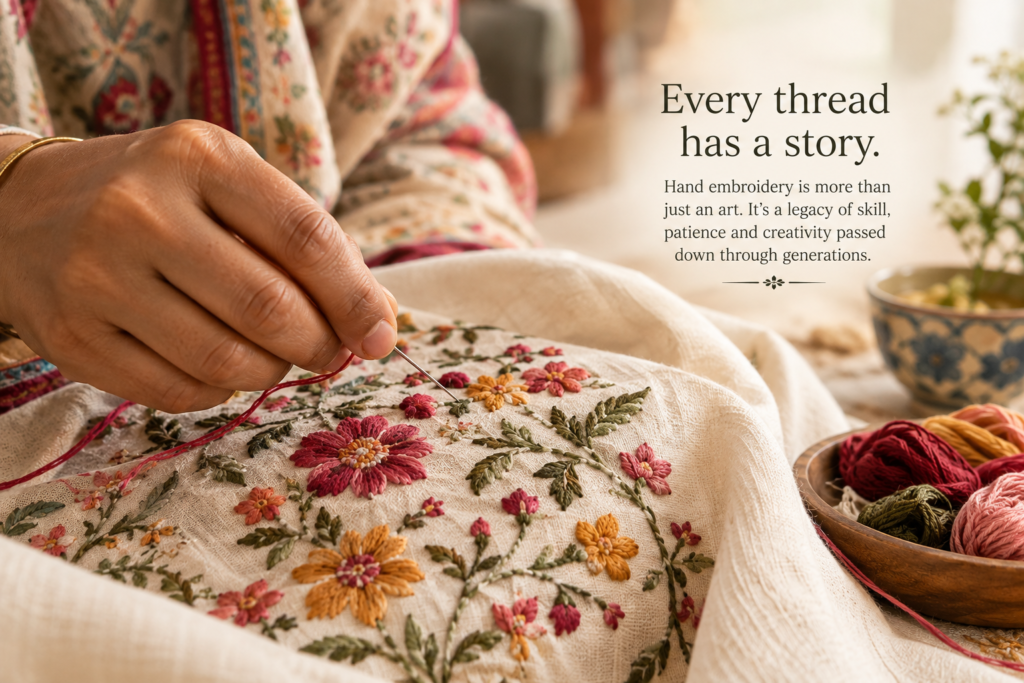
Every thread has a story.
A needle moves carefully through fabric. One stitch becomes another, patterns slowly take shape, and what begins as a simple piece of cloth becomes something deeply personal and beautiful. This is the quiet magic of hand embroidery—an art that requires patience, creativity, skill, and countless hours of careful work.
But handmade embroidery is about much more than beautiful designs.
Behind every carefully embroidered piece are skilled hands, creative minds, and stories of people who continue to keep traditional craftsmanship alive. For many women, traditional crafts can also create opportunities to earn through their skills, build confidence, and gain greater independence.
This is the idea that inspires Lahaboli—a hand embroidery brand rooted in Uttarakhand and created with a belief in the beauty and value of women’s craftsmanship.
The Timeless Beauty of Hand Embroidery
In a world where many products are manufactured quickly and in large quantities, hand embroidery offers something different.
It takes time.
Every stitch is placed intentionally. Every motif requires attention to detail. Unlike machine-made designs that can be reproduced within seconds, handmade embroidery reflects the individuality of the person who creates it.
Small variations in stitches, patterns, and textures are not imperfections. They are part of what makes a handmade product unique.
Traditional Indian embroidery has been an important part of the country’s craft heritage for generations. Across different regions, communities have developed distinctive techniques, motifs, colours, and styles, often passing their knowledge from one generation to the next.
Hand embroidery therefore represents more than decoration. It represents skill, heritage, patience, and human creativity.
The Women Behind the Threads
When we admire an embroidered product, it is easy to focus only on the finished piece.
But the real story begins much earlier.
It begins with the person holding the needle.
Women have long played an important role in India’s handmade craft traditions. Embroidery and other textile crafts have often been learned within families and communities, with skills passed from mothers and grandmothers to younger generations.
When these skills become opportunities for meaningful work, craft can take on another dimension.
For women artisans, access to craft-based work can provide an avenue to earn from their abilities. It can contribute to financial independence and provide a sense of recognition for skills that might otherwise remain unseen.
Empowerment does not always begin with something dramatic.
Sometimes, it begins with having the opportunity to turn a skill into an income.
Sometimes, it is the confidence that comes from knowing that your work is valued.
And sometimes, it is simply being able to say, “I made this.”
This is why supporting women artisans is about more than buying a product. It is about recognising the value of their time, creativity, knowledge, and craftsmanship.
Uttarakhand: Where Tradition Meets Creativity
Nestled in the Himalayas, Uttarakhand is known for its natural beauty, rich cultural traditions, and strong connection to community and craftsmanship.
For generations, traditional knowledge has been woven into everyday life—from food and textiles to art, music, and handmade crafts.
Lahaboli draws inspiration from this connection to place and tradition.
The brand was started by women of Uttarakhand with a vision to celebrate the beauty of hand embroidery while creating products that fit naturally into contemporary homes and lifestyles.
This balance between heritage and modern design is at the heart of Lahaboli.
The goal is not simply to recreate the past.
It is to carry the spirit of traditional craftsmanship forward in ways that feel relevant today.
Lahaboli: Craft with a Purpose
Lahaboli believes that handmade products can tell stories.
A beautifully embroidered table runner can become more than a piece of home décor. It can represent hours of work, artistic expression, and the skill of the person who created it.
A handcrafted gift can carry a different kind of meaning because it reflects time and human effort.
This is where Lahaboli’s philosophy comes alive.
By focusing on hand embroidery, Lahaboli celebrates the craftsmanship behind every piece. The brand brings together traditional artistic skills and designs that can complement modern homes.
At its heart is a simple idea:
Beautiful things can also have meaningful stories.
Lahaboli’s connection to women artisans is an important part of that story. Rather than viewing handmade craftsmanship simply as a product category, the brand recognises the people behind the work and the skills that make each creation possible.
Why Handmade Matters
Choosing handmade is a small decision, but it can have a meaningful impact on how we think about the things we bring into our homes.
Mass-produced products are designed for speed, scale, and consistency. Handmade products offer a different experience.
They invite us to slow down.
They encourage us to notice details.
They remind us that creating something beautiful takes time.
When you choose an artisan-made product, you are choosing to value the process as much as the final result.
You are recognising that a person spent time selecting materials, creating patterns, making stitches, correcting details, and completing the piece.
For traditional crafts, this recognition matters.
Craft traditions can survive only when skills continue to be practiced, valued, and passed forward. Supporting handmade products can help create demand for traditional skills and encourage their continued relevance.
Hand Embroidery and Sustainable Craftsmanship
The growing interest in conscious consumption has also encouraged many people to reconsider how they purchase and use products.
Sustainability is not only about materials. It can also involve the way products are made, how long they are valued, and whether the people behind them are recognised.
Handcrafted products naturally encourage a more thoughtful relationship with what we buy.
A carefully embroidered piece is not something that needs to be replaced simply because a new trend arrives. Its individuality can make it feel personal and timeless.
Choosing quality craftsmanship and caring for handmade products can help us move away from a culture of constant replacement and towards one where objects are appreciated for their story and longevity.
For Lahaboli, this philosophy connects craftsmanship with conscious living.
The aim is to create pieces that are beautiful enough to become part of everyday life while retaining the human touch that makes handmade products special.
From a Needle and Thread to Women’s Empowerment
Women’s empowerment can take many forms.
Education, entrepreneurship, employment, financial independence, leadership, and access to opportunities all play important roles.
Craft can be part of this larger picture.
For women with embroidery skills, the ability to earn through craftsmanship can create an opportunity to participate in the economy while continuing to work with a skill they know and value.
It can also create visibility.
A piece of embroidery that reaches a customer thousands of kilometres away carries more than a design. It carries evidence of the artisan’s skill.
Someone, somewhere, is appreciating something created by her hands.
That recognition matters.
And when customers consciously choose products made by women artisans, they help create a market where craftsmanship is valued not as a hobby or pastime, but as meaningful work.
https://www.instagram.com/lahaboliembroidery?stkn=aW54MTkzd3plYWVq&utm_source=qr
Why Your Choice Matters
Imagine two products sitting side by side.
One was produced within minutes by an automated process.
The other took hours of careful handwork.
Both may be beautiful.
But the second carries a story that begins with a person.
When you choose handmade embroidery, you are choosing to notice that story.
You are choosing craftsmanship over convenience.
You are choosing individuality over uniformity.
You are choosing to keep traditional skills visible.
And when that craftsmanship is created by women, your purchase can also become part of a larger story of opportunity and empowerment.
This does not mean that every purchase alone transforms a community. Real empowerment requires sustained opportunities, fair compensation, access to markets, skills development, and long-term support.
But every conscious choice can contribute to a culture where artisan skills are valued.
Keeping the Story Alive
Traditional crafts survive when people continue to practice them.
They survive when younger generations see value in learning them.
They survive when artisans are able to earn from their skills.
And they survive when customers choose to appreciate the work behind handmade products.
This is why the story of Lahaboli is ultimately a story about people.
It is about women who create.
It is about hands that know the rhythm of a needle.
It is about patterns inspired by tradition and designs created for contemporary spaces.
It is about preserving something beautiful while giving it room to evolve.
Most importantly, it is about recognising that behind every handmade product is a person whose time and skill deserve to be valued.
Every Thread Tells a Story
The next time you see a hand-embroidered piece, look beyond the pattern.
Look at the stitches.
Think about the patience required to create them.
Think about the knowledge behind the technique.
Think about the woman whose hands brought the design to life.
That is where the true beauty of handmade craftsmanship lies.
At Lahaboli, every thread is part of a larger story—a story of hand embroidery, women, creativity, heritage, and opportunity.
Because when we choose handmade, we do more than bring something beautiful into our homes.
We help keep craftsmanship alive.
We celebrate the people behind the work.
And sometimes, one small thread can become part of something much bigger.
Lahaboli — where every stitch carries a story.